Nigeria’s housing deficit isn’t just about a shortage of homes. It’s a qualitative crisis of standard housing. Discover why the crisis keeps growing.
The narrative surrounding Nigeria’s housing deficit has long been fueled by speculation, bulletproof assumptions, and outdated metrics. However, verified 2026 data from the National Housing Data Technical Committee has brought the cold, hard reality into sharp focus.
The nation is not simply failing to build enough rooftops; it is failing to maintain the structural integrity of the roofs already standing.
To understand why this crisis is expanding exponentially and where the actual structural friction lies we must dissect the problem beyond the sensationalized headlines.
The Two Dimensions of Nigeria’s Housing Crisis
The institutional data reveals that the crisis is two-dimensional, split almost equally between a lack of supply and a decay in structural quality.
1. The Quantitative Deficit: A Missing 14.92 Million Units
Nigeria currently lacks approximately 14.92 million housing units. This structural shortage is the primary driver behind the aggressive spikes in urban rents and severe overcrowding in Tier-1 commercial hubs like Lagos and Abuja. Demand has completely decoupled from supply, leaving low- and middle-income earners at the mercy of hyper-inflated rental markets.
2. The Qualitative Deficit: 15.2 Million Substandard Homes
Building new homes is only half the battle. The data shows that 15.2 million existing housing units are structurally inadequate. These properties lack basic sanitation, reliable utilities, or structural safety mechanisms. Essentially, millions of Nigerians are sheltered in properties that fail basic habitability standards.
The Capital Requirement: Resolving both the quantitative and qualitative gaps will require an estimated ₦21 trillion to ₦59 trillion in targeted capital injection.
Why the Deficit Keeps Growing: Systemic Drivers
The housing gap cannot be closed by goodwill or generic government pronouncements. The widening deficit is driven by distinct economic and systemic bottlenecks:
Hyper-Inflation in Construction Materials: Basic building blocks most notably cement, reinforcement steel, and finishing materials—have seen aggressive, unpredictable price surges.
Currency Depreciation & Logistics Friction: The local real estate supply chain remains heavily reliant on imported raw materials and specialized fittings. Combined with the depreciation of the Naira and volatile domestic transportation costs, development expenses have skyrocketed.
The Luxury Bias Among Developers: High corporate financing and interest rates push private developers directly toward the premium and luxury residential sectors. The logic is simple: luxury projects offer the fast, high-margin liquid exits required to service expensive short-term debt, completely leaving behind the affordable housing segment.
The Financing Matrix: Unlocking Local Capital
The scale of this deficit cannot be resolved by traditional commercial bank loans, which typically carry prohibitive short-term interest rates. Bridging a ₦59 trillion gap requires deep, long-term institutional liquidity.
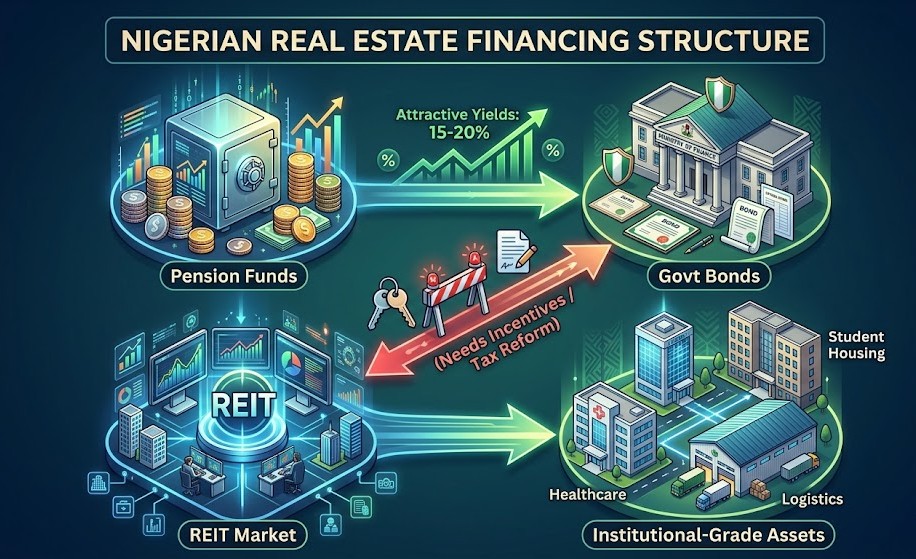
Historically, the Nigerian Real Estate Investment Trust (REIT) market has failed to scale because major institutional players—specifically Pension Fund Administrators (PFAs) prefer to channel liquidity into high-yielding government bonds offering risk-free returns.
To redirect this capital, the regulatory framework requires immediate modernization. For example, in mature African markets like South Africa, REIT operators are exempt from capital gains and income taxes provided they distribute 75% of their earnings. In contrast, Nigerian REITs are still bogged down by stamp duties and withholding taxes, which actively suppresses institutional interest.
For investors seeking sustainable passive income, the play is moving away from luxury residential bets and shifting toward asset classes with defensive, non-cyclical cash flows:
Student Accommodation: Purpose-built student housing near major academic institutions offers structural under-supply and high rent yield density.
Logistics & Cold Storage: Driven by the growth of regional commerce and e-commerce, institutional-grade warehousing remains highly lucrative.
Healthcare Real Estate: Digitally integrated clinics and localized diagnostic hubs offer consistent, long-term rental income.
The Strategic Takeaway
Nigeria’s housing deficit is no longer a generic social problem; it is a complex economic reality driven by supply-chain shocks, regulatory bottlenecks, and a mismatch in capital allocation. For first-time buyers, it demands alternative pathways like rent-to-own or flexible, long-term installment structures. For the high-net-worth investor and diaspora community, it means looking past overbuilt luxury residential corridors and focusing on structured, yield-rich alternative asset classes.
Maximize Your Real Estate Portfolio
The market belongs to those who trade on verified data, not speculative hype. Whether you are looking to hedge against inflation through defensive commercial assets or launch your first structured residential project, our team provides execution-ready market intelligence and legal advisory services.